
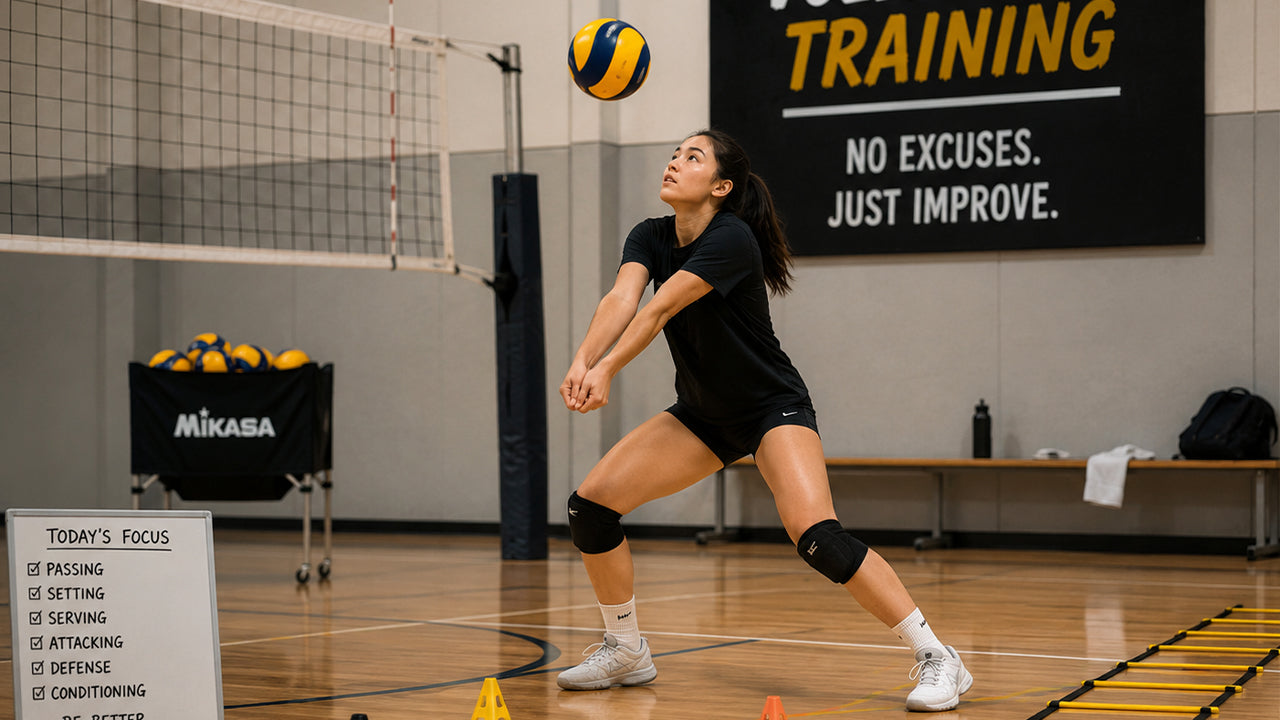
Most volleyball improvement happens in the gaps between team practices — and that's exactly where solo volleyball training earns its value. You don't need six teammates, a full court, or a coach standing by with a whistle to get meaningful reps. With the right setup and a focused plan, you can sharpen passing, setting, hitting, footwork, and conditioning entirely on your own. This guide breaks down six drills that work without a partner, plus a 45-minute session plan you can run anytime the gym is locked and nobody else is around.
The Problem: Skill Development Stalls Without Extra Reps
Team practice gives players structure, but it rarely gives them volume. In a two-hour session split across 10–14 athletes, an individual player might only touch the ball a few dozen times in each skill category. That's not enough repetition to build the kind of automatic, pressure-proof technique that shows up in close sets.
The gap shows up hardest for three groups of players: those without a regular practice partner, those in the off-season when team sessions disappear for months at a time, and younger players who need high-repetition fundamentals work before they're ready for live drilling. All three run into the same wall — skill decay happens fast without reinforcement, and "I don't have anyone to practice with" becomes the reason a serve, a platform, or an approach never quite improves.
The good news is that volleyball is one of the more solo-friendly sports to train. Passing, setting, and hitting mechanics can all be isolated and repeated without a second person, as long as you have a way to send the ball back to yourself consistently. That's the real bottleneck — not lack of a partner, but lack of a tool that returns the ball so you can keep your reps going.
The Solution: Six Drills Built for Solo Reps
Each of these drills is designed to be run alone, indoors or outside, with minimal setup. They target the core skills — passing, setting, hitting, footwork, and conditioning — so a full rotation through all six gives you a balanced, complete-player session.
1. Rebounder Passing Reps
Purpose: Build a stable forearm passing platform through high-volume repetition.
How it works:
Stand 8–10 feet from a volleyball rebounder, angle it to send the ball back at chest height, and pass it back continuously. Focus on a flat, locked platform and quiet feet — the rebounder punishes sloppy angles by sending the ball off in unpredictable directions, so it doubles as instant feedback on technique.
Reps: 5 sets of 20 clean passes. Reset the count if your platform breaks down (bent elbows, swinging arms).
Coaching cue: Let your legs absorb the ball's force — your arms should be a stable surface, not the source of power.
2. Toss-and-Set Wall Drill
Purpose: Develop soft hands and consistent contact for setting.
How it works: Toss the ball up against a wall or net post, get under it quickly, and set it back to the same spot using proper hand shape. No wall needed if you have a volleyball training net — set the ball up and over, then chase it down and reset.
Reps: 4 sets of 15 sets, alternating between setting forward and setting backward (back-sets).
Coaching cue: Get your feet under the ball before your hands go up — footwork, not arm strength, determines a clean set.
3. Solo Spike Trainer Approach and Arm Swing
Purpose: Groove approach footwork and full arm-swing mechanics without needing someone to toss for you.
How it works:
A solo volleyball trainer suspends the ball at a fixed, repeatable height, letting you run a full three-step approach and hit through the ball at game speed, every single rep. Because the ball resets automatically, you can chain dozens of full-speed swings together without breaks to retrieve it.
Reps: 6 sets of 8 full approaches. Rest 30–45 seconds between sets to keep swing speed high.
Coaching cue: Plant your last step wide and low for explosive vertical lift — a rushed, narrow final step kills jump height.
4. Rebounder Rapid-Fire Reaction Drill
Purpose: Sharpen reaction time and ball control under speed.
How it works:
Set your volleyball rebound net at a steeper angle so the ball returns faster and less predictably. Pass or set it back as quickly as possible for a set time window rather than a set number of reps — this forces you to react instead of anticipate.
Reps: 5 rounds of 30 seconds on, 30 seconds rest.
Coaching cue: Stay on the balls of your feet between touches so you can adjust your angle in a split second.
5. Approach Footwork Ladder (No Ball)
Purpose: Isolate footwork patterns so your approach becomes automatic before you add a ball.
How it works: Mark a standard left-right-left (or right-left-right for lefties) approach pattern with tape or cones. Run the pattern at game speed without a ball, focusing purely on rhythm, step length, and arm swing timing into the jump.
Reps: 4 sets of 10 approaches, alternating which foot leads.
Coaching cue: Your steps should accelerate — short, medium, long — not stay the same length throughout.
6. Conditioning Finisher: Plyometric Circuit
Purpose: Build the explosive leg power and endurance that volleyball demands in long rallies and five-set matches.
How it works: Run a circuit of lateral shuffles, broad jumps, and tuck jumps with minimal rest between exercises. This isn't volleyball-specific contact work, but it directly supports every jumping and lateral-movement skill in the sport.
Reps: 3 rounds of: 10 lateral shuffles each direction, 8 broad jumps, 10 tuck jumps. Rest 60 seconds between rounds.
Coaching cue: Land soft and quiet on every jump — loud landings mean you're not absorbing force efficiently, which raises injury risk over a season.
Practice Plan: A 45-Minute Solo Session
Here's how to string these drills into one complete session you can run on your own, two to three times a week.
Minutes 0–5 — Dynamic warm-up. Leg swings, arm circles, light jogging, and a few unloaded jump reps to raise your heart rate and prep your joints.
Minutes 5–15 — Rebounder Passing Reps (Drill 1). Start here while you're fresh, since passing technique depends heavily on body control.
Minutes 15–25 — Toss-and-Set Wall Drill (Drill 2). Move into setting work, alternating forward and back-sets.
Minutes 25–35 — Solo Spike Trainer Approach (Drill 3). This is your highest-intensity skill block — do it before fatigue sets in too deep.
Minutes 35–40 — Rebounder Rapid-Fire Reaction Drill (Drill 4). A short, high-intensity finisher for ball control under speed.
Minutes 40–45 — Conditioning Finisher (Drill 6). Close the session with the plyometric circuit while your legs still have enough left to move with good form.
Rotate in the Approach Footwork Ladder (Drill 5) on alternating days in place of the spike trainer block if your legs need a lighter day, or use it as a pure warm-up extension before live hitting reps.
Track your numbers — passing platform success rate, sets completed cleanly, swings per session — in a simple log. Solo training can feel directionless without a way to measure progress, and a written log turns vague effort into visible improvement week over week.
Equipment Recommendations
The drills above work because each one solves the core problem of solo training: getting the ball back to you quickly and consistently so reps don't die waiting on a retrieval.
A volleyball rebounder is the single most versatile tool for solo work — adjust the angle and you can target passing, setting, or even approach-and-hit reps off the rebound. It's the foundation for Drills 1 and 4 above, and it pays for itself the first week you'd otherwise have spent chasing loose balls across the gym.
For hitting mechanics specifically, a solo volleyball trainer is hard to replace. It's the only practical way to get full-speed, full-approach swing reps without a setter feeding you balls, which makes it the backbone of Drill 3.
If you're building out a full backyard or garage setup, pairing either tool with a training volleyball that matches official size and weight keeps your touch calibrated to game conditions, rather than adapting to a ball that feels different from what you'll use in matches.
Conclusion
Solo volleyball training won't replace live team reps, but it closes the gap between practices and keeps your fundamentals sharp when a partner isn't available. Six focused drills — passing, setting, hitting, reaction work, footwork, and conditioning — cover the full skill set a player needs, and a tool like a rebounder or spike trainer turns "I have nobody to practice with" into a non-issue. Consistent practice with the right drills and training equipment can help players accelerate development throughout the season.

Leave a comment
This site is protected by hCaptcha and the hCaptcha Privacy Policy and Terms of Service apply.