
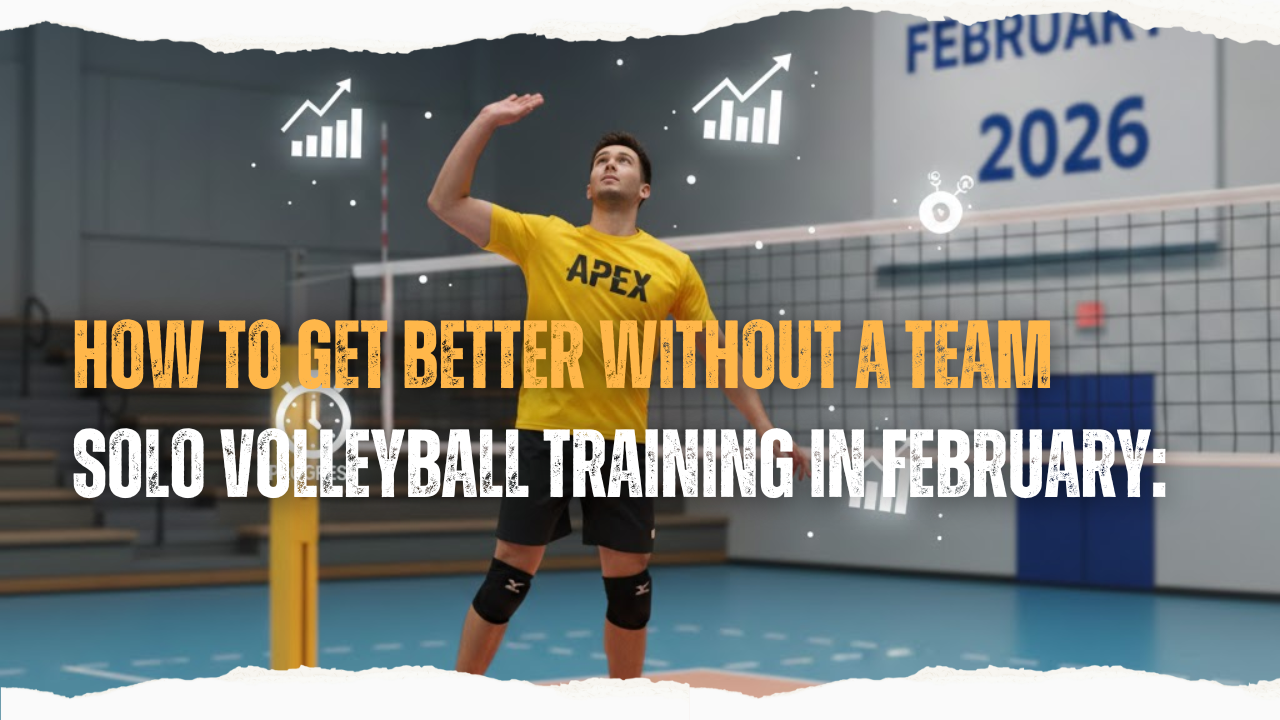
It’s February 2026. Club season is approaching (or already starting), tryouts are on the horizon, and gym time still isn’t guaranteed. For many high school volleyball players, this stretch feels awkward—you’re no longer “off,” but you’re not fully back into team reps either.
That gap? It’s actually where serious improvement happens.
Sports science shows that focused, individual training in February can sharpen mechanics, clean up weaknesses, and set you apart once team play ramps up. Volleyball is a team sport, but performance is built on individual reps. Here’s how to use research-backed methods—and smart tools—to make solo training your advantage this month.
1. The Power of High Repetition (Blocked Practice)
In team practices or scrimmages, touches are limited. You might pass once, then wait minutes for the next rep. Solo training unlocks blocked practice, where one skill is repeated consistently.
Research published in The Journal of Motor Behavior shows blocked practice is especially effective for improving technique and motor patterns, which is exactly what February training should focus on.
Why it matters in February:
This is the month to clean up mechanics before speed and chaos increase in competition.
How to train it:
- Use a wall or a rebound-style trainer to get continuous reps
- Aim for 50–100 quality contacts in one session
Apex Edge:
Tools like the Apex Volleyball Rebounder or Apex Training Station allow you to pass, set, and react without chasing the ball—meaning more reps, less downtime.
Focus cue: Platform stability and consistent angles
Drill: Stand 5–7 feet from the rebound surface. Perform 50 controlled passes or sets to the same target, emphasizing balance and clean contact.
2. Sharpening Game IQ Through Visualization
Physical reps aren’t the only way to improve. Studies from the Association for Applied Sport Psychology show that mental imagery activates the same neural pathways as physical execution.
When team reps are limited, visualization keeps your brain game-ready.
The February Method:
- Spend 10 minutes a day visualizing real game situations
- Picture yourself in serve-receive, transitioning to attack, or defending a fast offense
- Feel the timing, hear the calls, and imagine clean execution under pressure
Elite athletes don’t wait for matches to prepare mentally—they rehearse success before it happens.
3. Building Explosive Power Without a Net
February is prime time for developing power without overloading your body. According to research in the International Journal of Sports Physiology and Performance, vertical jump and lateral quickness respond best to plyometric and strength-based training, not endless scrimmaging.
Without long team practices draining your CNS (central nervous system), recovery improves—and gains come faster.
Key movements:
- Depth Jumps: Step off a box and explode upward
- Lateral Bounds: Mimic defensive slides and block closes
- Approach Jumps: Train timing and explosiveness without a ball
Apex Tie-In:
Pair jump work with skill reps using the Apex Spike Trainer, which allows you to groove arm swing mechanics and timing without needing a setter or full court.
4. Self-Correction: Becoming Your Own Coach
One risk of solo training is reinforcing bad habits. But athletes who develop self-regulated learning (SRL)—the ability to analyze and adjust their own performance—often progress faster long-term.
A study in Frontiers in Psychology found that athletes who actively self-evaluate reach higher competitive levels.
The Hack:
- Record 20–30 seconds of your passing, setting, or arm swing
- Compare it to slow-motion footage of high-level players
- Look for angles, timing, and posture—not just results
Using video alongside structured tools (like rebounders or spike trainers) helps you isolate technique and fix issues before they show up in matches.
February Solo Training Focus Areas
| Focus Area | Performance Benefit | Solo Tool Needed |
|---|---|---|
| Ball Control | Muscle memory & consistency | Wall or Apex Rebounder |
| Vertical Jump | Power output & explosiveness | Box, stairs, bodyweight drills |
| Arm Swing | Timing & attacking efficiency | Apex Spike Trainer |
| Game IQ | Faster decision-making | Visualization & game film |
| Footwork | Balance, speed, and court awareness | Cones or Apex Training Station |
Final Takeaway
February isn’t a waiting period—it’s a separator.
The players who show up sharper, faster, and more confident later this spring won’t be the ones who waited for team practices to return. They’ll be the ones who used solo reps, smart tools, and intentional training to build their foundation early.
Train now so when the gym gets loud again, your game speaks for itself. 🏐🔥

Leave a comment
This site is protected by hCaptcha and the hCaptcha Privacy Policy and Terms of Service apply.