
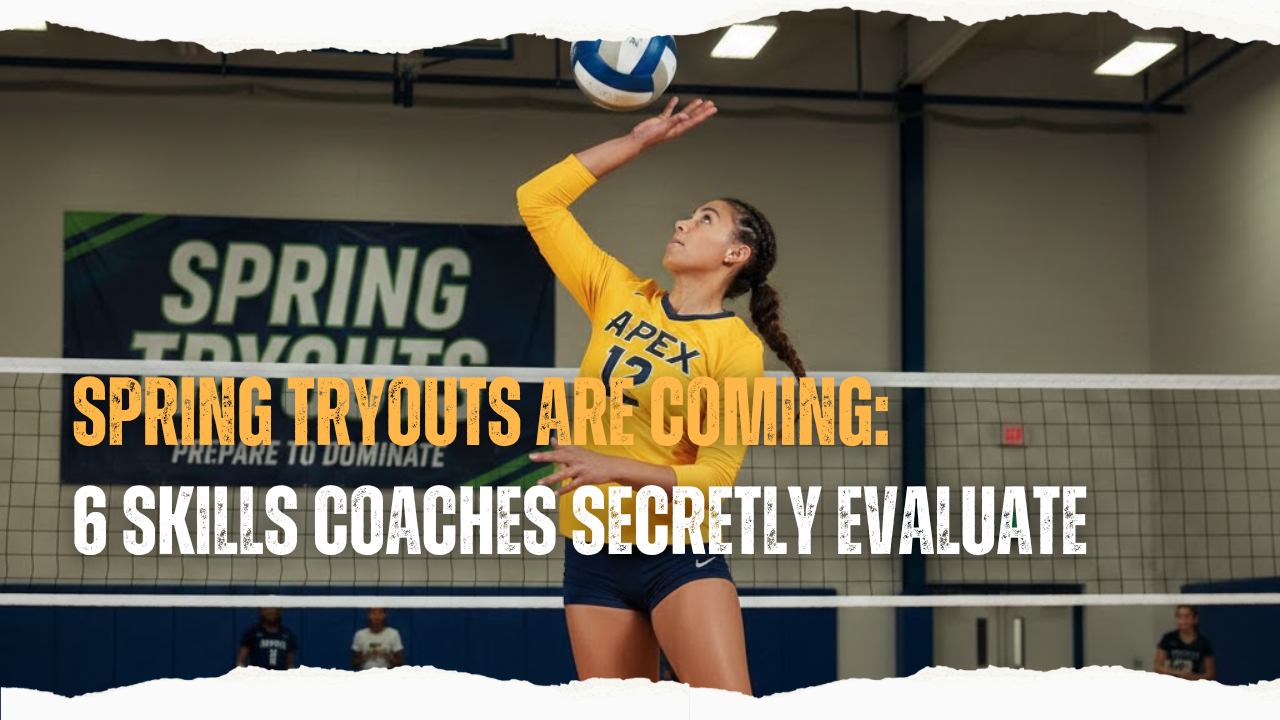
The gym is loud, the air is thick with the scent of floor wax, and you’ve got about two hours to prove you belong on the roster. Most players focus on the highlight reel—the monster block or the deep cross-court spike—but veteran coaches are often looking at the "invisible" data points that determine if a team wins or crumbles under pressure.
If you want to move from the bubble to the starting lineup, you need to master the skills that high school coaches evaluate when they think you aren’t looking. Here are the six secret metrics of a successful tryout, backed by sports science.
1. Serve (and Skill) Consistency
In volleyball, the serve is the "first tactical attack," and research shows it’s a decisive factor in match outcomes regardless of what the opponent does (Lima et al., 2021). But coaches aren't just looking for an ace; they’re looking for predictability.
A "power player" who serves into the net 40% of the time is a liability. Coaches value "Block Practice"—the ability to repeat a movement with high fidelity—because it creates a stable floor for the team’s performance. To build this at home, using an Apex Adjustable Volleyball Net allows you to drill your contact point until it’s muscle memory.
2. First-Step Quickness
Speed isn't just about your 40-yard dash; it’s about Speed, Agility, and Quickness (SAQ). In fast-paced court sports, high-speed actions lead to points, even though they only make up a small fraction of total game time (Sun et al., 2025).
Coaches are watching your "initiation" phase. Do you explode toward the ball, or do you "false step"? Improving your reactive ability—how fast your brain tells your muscles to move after a whistle—is vital. You can sharpen this by practicing digs and resets against an Apex Adjustable Volleyball Rebounder, which forces you to react to unpredictable, high-velocity returns.
3. Communication: The "Volume" Metric
Effective communication isn't just about being loud; it’s about reducing "misunderstanding noise." A study on team dynamics found that teams with high-quality verbal and non-verbal communication saw a significant reduction in game-day errors (McCarthy, 2025).
Coaches evaluate:
- Directional Talk: Calling "mine," "out," or "switch."
- Non-Verbal Cues: High-fives and eye contact.
- Active Listening: Can you take a correction and apply it on the next rep?
4. Transition Speed
Transition isn't just running; it's the mental shift from offense to defense. Research defines "Transitional Speed" as the ability to move swiftly between locations while maintaining tactical awareness (Khuraibit, 2014).
When the ball changes hands, a coach’s eyes go straight to the players away from the ball. Are you sprinting to get behind the line? High-level coaches prioritize players who "hunt the transition." Practicing your approach and reset using the Apex Volleyball Training Net System helps you simulate these game-like movements without needing a full team present.
5. Effort Level (The "Grit" Factor)
"Grit"—defined as passion and perseverance for long-term goals—is a better predictor of athletic success than raw talent (Duckworth, 2007). In a tryout setting, this looks like pursuit.
Do you dive for a ball that's out of reach? Do you hustle to the back of the line? Coaches use these "effort triggers" to gauge your resilience. Using a high-quality Apex Professional Volleyball during solo drills helps maintain that game-day feel, ensuring your effort translates directly to the official size and weight you'll see at tryouts.
6. Conditioning & Fatigue Resistance
Finally, coaches watch you in the final 15 minutes. Fatigue resistance is your ability to maintain "technical proficiency" when your heart rate is high (Hunter, 2026). If your form breaks down at the end of the session, it tells a coach you might struggle in the fifth set.
To keep your mechanics sharp even when you're tired, try high-rep sessions with an Apex Volleyball Spike Trainer. It allows you to focus on your arm swing and timing repeatedly, building the endurance needed to keep your vertical high and your swing powerful until the final whistle.
Gear Up for the Grind
To keep your performance at its peak, make sure your kit is as ready as your mind. Whether you're refining your touch with an Apex Professional Volleyball or setting up a full Apex Training Station in the backyard, the right gear ensures your body can keep the promises your spirit makes.
Are you ready to turn repetition into results? Check out the full Apex Training Collection to start your prep today.
Citations:
- Lima, R., et al. (2021). "A comparative study between serve mode and speed." ResearchGate.
- Sun, M., et al. (2025). "Effects of SAQ training on athlete performance." PLOS One.
- McCarthy, P. (2025). "The Subtle Psychology of Effective Communication."
- Khuraibit, A. (2014). "Transitional Speed and Tactical Awareness in Court Sports."
- Duckworth, A. (2007). "Grit: Perseverance and passion for long-term goals." Journal of Personality and Social Psychology.
- Hunter, S. (2026). "Fatigue Resistance and Technical Proficiency." Marquette University.

Leave a comment
This site is protected by hCaptcha and the hCaptcha Privacy Policy and Terms of Service apply.