
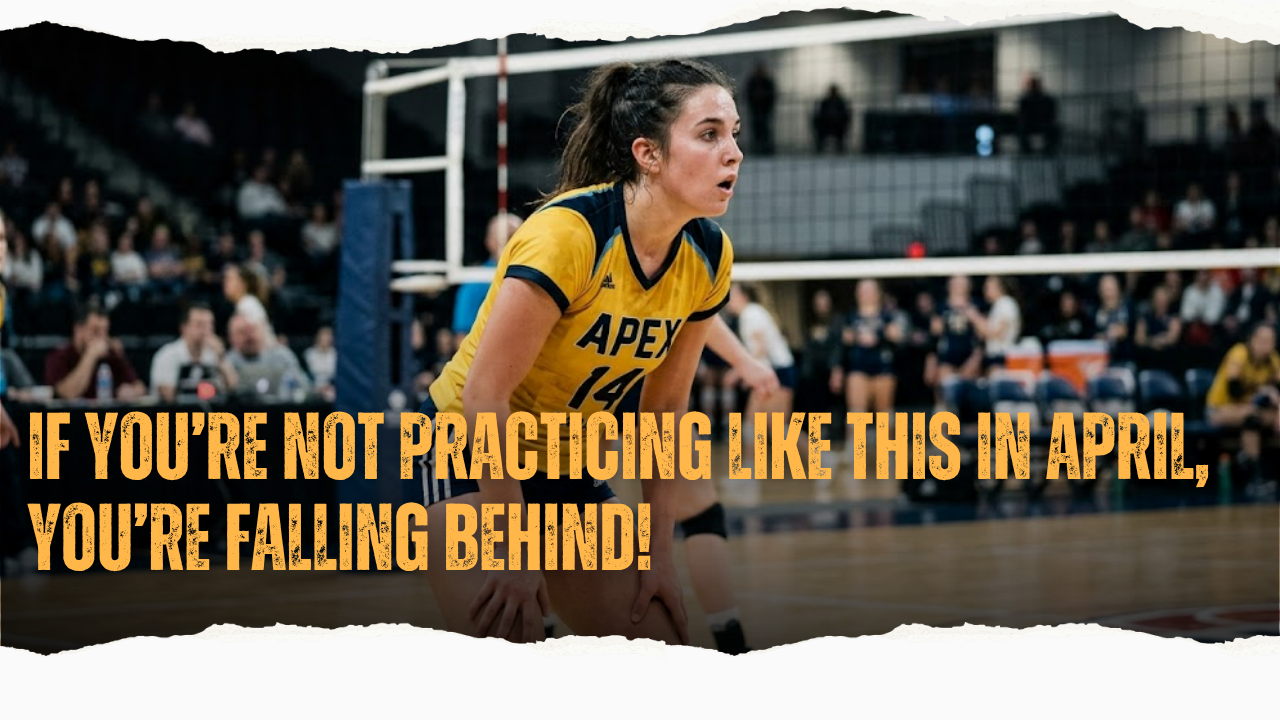
If You’re Not Practicing Like This in April, You’re Falling Behind
The Science of Why "Just Showing Up" Isn't Enough Anymore.
It’s April. The "new season smell" has worn off. The grind has set in. For high school and college athletes, this is the danger zone—the time when most players slip into "maintenance mode." They show up, do the drills the coach says, and go home.
But here’s the cold, hard truth: If you’re just doing what everyone else is doing, you’re staying exactly where everyone else is.
According to research into Deliberate Practice (the gold standard of athletic development), the difference between a "good" player and an "elite" player isn't just hours—it's intent. If you aren’t practicing with these three scientific principles this month, you are officially falling behind.
1. The Death of "Mindless Reps"
A study published by USA Volleyball on Deliberate Practice found that "mindless" repetitions—like forearm passing 20 easy tosses—offer almost zero benefit for skill acquisition. Why? Because your brain isn't being challenged.
To actually improve, your training needs intense focus and measurement.
- The Fix: Stop just hitting the ball. Set a goal: "I will hit 8 out of 10 balls into the deep corner." * The Tool: Use an Apex Sports Volleyball Training Net System. Having a specific target system forces your brain to adjust every rep based on success or failure. That "adjustment" is where the learning actually happens.
2. The "Game-Like" Requirement
Research in the Journal of Motor Learning suggests that Random Practice (where drills mimic the unpredictability of a game) is far superior to Blocked Practice (doing the same motion over and over).
In April, many athletes get stuck in Blocked Practice because it feels "safe." But games aren't safe—they're chaotic.
- The Strategy: You need reps that fight back. If you’re practicing solo, a flat wall won’t cut it because the bounce is too predictable.
- The Upgrade: An Adjustable Volleyball Rebounder Net creates unpredictable returns. It forces you to read the ball, adjust your feet, and react—just like you’re in the fifth set of a playoff game.
3. Solving the "Repetition Gap"
By mid-April, team practices often shift toward "scrimmaging" to prepare for tournaments. While scrimmaging is great for chemistry, it’s terrible for individual skill volume. In a 20-minute scrimmage, you might only touch the ball 15 times.
To bridge the gap, you need High-Frequency Technical Training. > The Science: Studies show that athletes in the "Associative Stage" of learning (most HS/College players) need high-volume, correct repetitions to make a skill permanent.
If you aren't getting 100+ swings a day, your swing isn't getting better—it's just staying the same. Setting up a Volleyball Spike Trainer at home allows you to get those 100 swings in 15 minutes before dinner. That’s 3,000 extra reps a month. You can't "out-talent" someone who has 3,000 more reps than you.
Your April Audit
Ask yourself these three questions before you head to the gym today:
- Am I tracking my success rate? (If you don't have a number, you're just exercising, not training.)
- Is my environment unpredictable? (Are you reacting, or just going through the motions?)
- Am I getting "Extra-Curricular" reps? (Team practice is the minimum requirement; what you do at home is the competitive advantage.)
The Bottom Line
The athletes who make the "Jump" from JV to Varsity, or from the bench to the starting lineup, are the ones who take ownership of their development. April is the month of the "Separator." Don't just work hard—work deliberately.
Ready to out-train the competition? Stop relying on gym time alone. Build your home lab with professional-grade gear from the Apex Sports Volleyball Collection.
Which skill are you currently getting the fewest reps on in team practice?

Leave a comment
This site is protected by hCaptcha and the hCaptcha Privacy Policy and Terms of Service apply.